
Course Overview
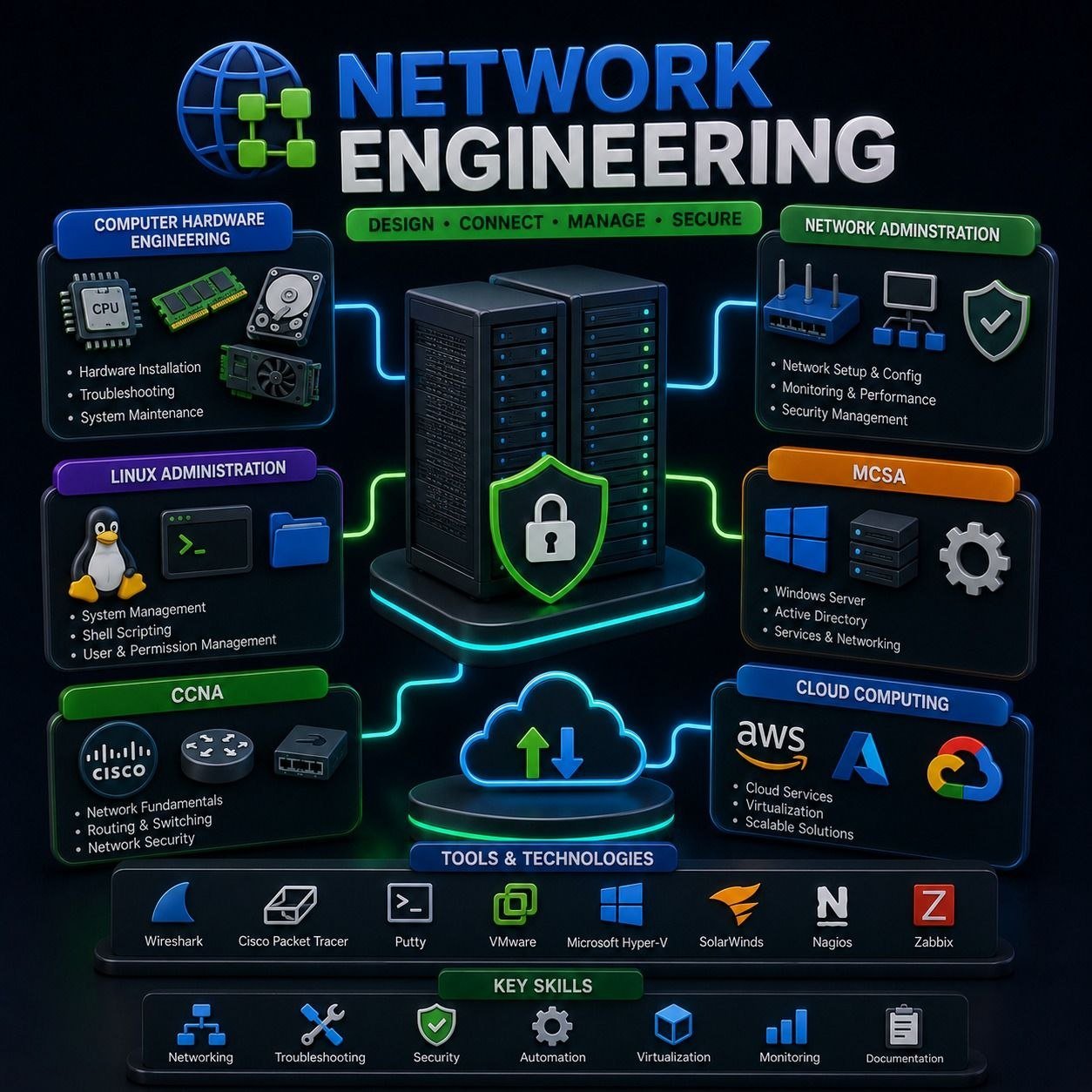
This professional program is designed to build complete expertise in modern IT infrastructure. Starting from the physical architecture of computer systems, students progress through advanced network administration, Linux server environments, and Microsoft enterprise solutions. The curriculum culminates with high-level Cisco networking and AWS Cloud architecture, preparing you for global certifications and industrial engineering roles.
Course Syllabus Matrix
01. Computer Hardware Engineering
- Systems & Architecture: Introduction & System Theory, Internal Architecture of Computer systems, and Peripheral functions.
- Assembly & OS: Disassembling and Assembling, Partitioning, Formatting & System Configuration, and Installing Windows OS.
- Maintenance: Installing system Drivers & Utilities, Upgrading, Servicing & Maintaining Computers, and System Troubleshooting Problems.
02. Network Administration
- Fundamentals: Introduction to Network, Hardware Components, and physical Network Cable preparation.
- Computational Logic: Understanding Number systems, Conversion, Logic gates, and Computer Arithmetic (Binary, 1's & 2's Complement).
- Addressing & Groups: Classes of Address (Private vs Public), Workgroup & Domain Network configuration, and Remote Configuration.
03. Linux Administration
- Core Management: Linux System Structure, Boot Process, Software Package Admin, User/Group Admin, and Advanced Permissions.
- Storage & Services: LVM, Disk Partitioning, Backup and Recovery, Configuring NFS, NIS Servers, and DNS (BIND 9).
- Server Deployment: DHCP, FTP, Proxy (SQUID), Samba, Mail Server, Log Server, Shell scripting, and Troubleshooting Linux.
04. MCSA (Microsoft Certified Solutions Associate)
- Domain Infrastructure: Creating Domain Environments, User Accounts, Organizational Units (OU), and Group Policy Management.
- Enterprise Services: Configuring DNS, DHCP, IIS (web) Server, RIS Server, Proxy Server, and Print Servers.
- Security & Storage: Implementing Windows Firewall Security and advanced Disk Management.
05. CCNA (Cisco Certified Network Associate)
- Routing Logic: Three Level Hierarchical Structure, Subnetting, VLSM, CIDR, OSI Layers, and IP Routing (Static & Default).
- Dynamic Protocols: Configuring RIP, EIGRP, and OSPF. Managing DHCP, SDM, and Wireless LAN.
- Switching & Security: VLAN & Inter VLAN Routing, Network Security (ACL), NAT & PAT, WAN, STP, and RSTP.
06. Cloud Computing (AWS)
- AWS Core: Global Infrastructure, Shared Responsibility Model, AWS Pricing, and IAM (Roles, Policies, Identity Center).
- Compute & Networking: Amazon EC2, Auto Scaling, Elastic Load Balancing, and Custom VPC (Virtual Private Cloud) design.
- Advanced Cloud: Security Groups, NACLs, AWS Storage, Database Services, DevOps on AWS, and Containers/Serverless.
Development Projects
- Active Directory Deployment: Building a complete centralized enterprise network with Group Policies and domain-level security controls.
- Cisco Enterprise Routing: Engineering a multi-layered switched network implementing OSPF dynamic routing and secure VLAN segmentation.
- AWS Infrastructure Design: Provisioning a scalable cloud architecture with custom VPCs, Load Balancers, and auto-scaling virtual server clusters.
Hands-On Learning Opportunities
Training involves direct interaction with physical hardware and industry-standard simulators. You will practice manual motherboard diagnostics, crimp network cables, configure Linux terminal environments, manage live Windows Server domains, and architect virtualized cloud environments on the AWS platform.
Who Should Enroll?
- IT Aspirants: Individuals starting from zero who want a full-stack career in IT Infrastructure and Systems.
- Support Technicians: Hardware technicians looking to upgrade their skills into Server Administration and Cloud Engineering.
- Future Cloud Architects: Students aiming to master the networking fundamentals (CCNA/MCSA) required to excel in high-level Cloud roles.
Why Choose This Course?
This is one of the few programs that bridges the gap between physical hardware engineering and virtualized cloud computing. By mastering the 6 core domains—Hardware, Networking, Linux, Microsoft, Cisco, and AWS—you gain the versatile skill set demanded by top-tier enterprise IT departments worldwide.